Source & Benchmark Reference
Databricks Document Intelligence: pushing the frontier for complex document extraction
As a Databricks partner and enterprise AI consultant, every new capability naturally gets my attention. But I try to look beyond the product announcement.
Does it solve a genuine enterprise problem? Is it materially different from what is already available? How does it compare with alternatives from AWS, Microsoft and Google? Most importantly, can it be trusted in workflows involving contracts, payments, compliance or customer decisions?
Databricks' new Precision Mode for AI Extract deserves attention because it addresses one of the most persistent challenges in enterprise AI: converting complex documents into accurate, structured and governed data.
At first glance, document extraction appears simple. Give an AI system a contract, invoice or lease and ask it to return the parties, dates, values, clauses and line items.
In practice, this is where many otherwise impressive AI systems begin to struggle.
The problem is not simply reading a PDF
Enterprise documents are rarely clean blocks of text.
A lease may define renewal terms on the first page but qualify them through a clause on page 80. A contract may redefine an important term more than 100 pages later. A bill of lading may contain hundreds of SKUs, while an invoice could contain thousands of line items.
Databricks identifies three particularly difficult extraction problems:
- Long documents: Information must be connected across pages and sections.
- Large, nested outputs: Models may omit, truncate or incorrectly merge fields as the required output grows.
- Complex schemas and reasoning: The required value may need to be calculated or derived from several parts of the document.
These are not merely OCR problems.
OCR may correctly recognise every word while the extraction system still produces an incomplete or inconsistent result. The real challenge is preserving the meaning, relationships and structure of the document at scale.
What Databricks has built
Precision Mode is a new mode within the Databricks ai_extract function, part of the company's broader Document Intelligence capabilities.
With ai_extract, users define the structure they want returned. This could be a few simple fields or a detailed JSON schema containing nested objects, arrays, data types and field descriptions.
Precision Mode is designed for the harder end of that spectrum:
- Long documents containing cross-references
- High-volume outputs with hundreds or thousands of fields
- Large and deeply nested schemas
- Tables containing extensive line-item data
- Extraction tasks requiring document-level reasoning
Databricks says it has addressed the problem at two levels.
First, it trained custom, efficient models specifically for structured document extraction. Instead of relying entirely on increasingly large general-purpose models, these models are optimised to find, interpret and return information according to a predefined schema.
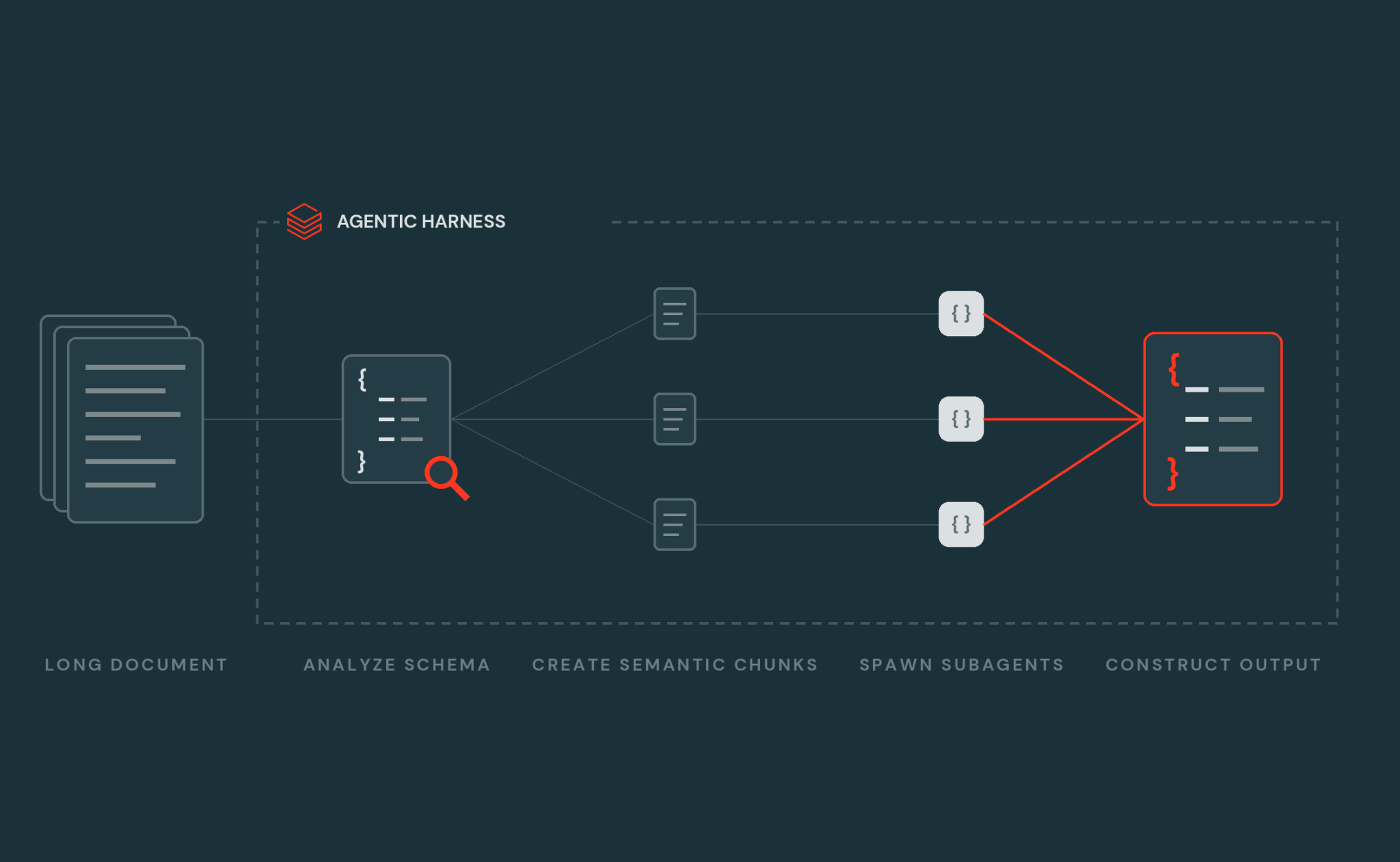
Second, it built an agentic extraction harness around those models.
The harness semantically decomposes a large extraction job into smaller tasks, runs them in parallel, preserves intermediate results and reconciles them into one final structured output.
This is an important distinction.
A common solution for processing long documents is to divide them into smaller chunks, extract information from each chunk independently and merge the results. This works for simpler use cases but can fail when information in one section changes the meaning of another. It can also result in timeouts, truncated responses, missing fields and incomplete merges.
Precision Mode has been designed specifically around these failure modes.
The benchmark results deserve attention
Databricks evaluated Precision Mode on approximately 9,000 complex documents drawn from 10 internal datasets and five public benchmarks.
The evaluation included:
- Documents of up to 2,000 pages
- Invoices containing thousands of line items
- Dense tables and charts spanning multiple pages
- Schemas containing more than 300 deeply nested fields
- Tasks requiring information to be cross-referenced across a document
The documents included 10-K filings, bills of lading, technical manuals, financial documents, clinical notes, patent applications and government funding applications.
Databricks compared Precision Mode with chunk-and-merge pipelines using leading GPT, Claude and Gemini models with their default API settings.
94.7% Extraction Accuracy
7 percentage points higher than the strongest frontier-model baseline tested, GPT-5.6 Sol.
According to Databricks' published results, Precision Mode achieved 94.7% extraction accuracy. This was seven percentage points higher than the strongest frontier-model baseline tested, GPT-5.6 Sol.
That is impressive, particularly because the evaluation was not restricted to short, standardised invoices.
However, it is important to interpret the number correctly.
Databricks defines accuracy as the proportion of extracted objects matching the ground-truth objects. Primitive values are assessed through direct matching. Strings may be evaluated using direct matching, fuzzy matching and an LLM judge. Arrays are matched with the closest expected items, while objects are scored across their individual fields.
Therefore, 94.7% is a benchmark result achieved across specific datasets using Databricks' published evaluation methodology. It is not a guarantee that every customer, document type or production workload will achieve the same accuracy.
Document quality, language, handwriting, schema design, field definitions and variation across templates can all affect performance.
For me, the positive point is that Databricks has published the composition of the benchmark, the baseline approach and the scoring methodology. This makes it possible to understand what was actually measured rather than relying on a generic claim of “high accuracy.”
How does it compare with other document solutions?
Databricks is not entering an empty market. Amazon, Microsoft and Google already provide mature document-processing capabilities.
Amazon Textract extracts printed text, handwriting, forms, tables, signatures and responses to document queries. AWS also provides specialised APIs for expenses, identity documents and lending, while Custom Queries adapters can be trained for business-specific documents.
Azure AI Document Intelligence offers prebuilt and custom extraction models, including custom neural models that can be adapted to an organisation's documents. It supports text, tables, key-value pairs, document structure and confidence information for extracted fields.
Google Cloud Document AI provides pretrained processors and custom extractors using foundation-model, custom-model and template-based approaches. It also supports derived fields that can calculate or infer information using the wider document context.
All three are credible platforms, particularly for organisations already deeply invested in their respective cloud ecosystems.
However, the Databricks announcement does not contain a direct benchmark comparison with Amazon Textract, Azure AI Document Intelligence or Google Document AI. It would therefore be inaccurate to use the reported 94.7% result to claim that Precision Mode is more accurate than these services.
The seven-point improvement relates specifically to the strongest frontier-model chunk-and-merge baseline evaluated by Databricks.
The differentiation I see in Databricks is therefore not only model accuracy. It is also architectural.
A document-intelligence workflow can combine:
ai_parse_documentfor layout-aware document parsingai_classifyfor classification and routingai_extractfor schema-based structured extraction- Citations linking extracted values to their source
- Confidence scores for individual fields
- Lakeflow for pipeline orchestration
- Unity Catalog for security, governance and lineage
- Agent Bricks for downstream AI applications
- Databricks SQL for analysing the extracted data
For organisations already using the Databricks Data Intelligence Platform, this could reduce the number of separate services and custom integrations required to operationalise document intelligence.
The comparison is therefore not simply, “Which API can read a PDF better?”
It is also, “Which approach fits most effectively into the organisation's data, governance, analytics and AI architecture?”
What excites me as a consultant
What excites me is not the ability to extract another invoice number. Many platforms can already do that.
The larger opportunity is helping enterprises treat documents as governed data sources rather than static files.
Contracts, leases, claims, regulatory filings, technical manuals and financial reports contain some of the most valuable information within a business. Yet much of this information remains inaccessible to analytics and AI applications because it is stored in document form.
From a consulting perspective, Precision Mode potentially changes the conversation.
Instead of discussing isolated OCR projects, we can help customers design governed document-intelligence pipelines that connect ingestion, parsing, classification, extraction, validation, analytics and downstream AI agents.
Potential use cases include:
- Comparing obligations and commercial terms across thousands of contracts
- Identifying renewal, termination and price-escalation provisions
- Reconciling invoices, purchase orders and shipping documents
- Extracting structured information from regulatory correspondence
- Converting maintenance reports and technical manuals into operational intelligence
- Analysing financial statements and filings across multiple periods
- Giving enterprise agents access to structured information linked to source evidence
The availability of field-level citations and confidence scores is particularly important.
For business-critical processes, the objective should not be blind automation. A more responsible design is to automate high-confidence cases, send uncertain values for human review and preserve evidence showing where each extracted value originated.
What I would still evaluate before production
I am excited about Precision Mode, but excitement is not the same as production approval.
Before recommending it for an enterprise workflow, I would evaluate it using the organisation's actual documents and compare it with the relevant alternatives.
That evaluation should include:
- Accuracy for each business-critical field
- Performance across document templates and scan qualities
- Cross-page and cross-clause reasoning
- Completeness of large tables and arrays
- Handling of amendments and conflicting information
- Citation accuracy and source traceability
- Confidence-score calibration
- Processing time and cost per document
- Exception handling and malformed files
- Regional availability, security and compliance requirements
- Integration effort with existing applications and workflows
Overall accuracy alone is not sufficient.
A system can perform exceptionally well across most fields while repeatedly failing on the one payment, contractual or regulatory field that carries the greatest risk. Extracting a supplier address and extracting an invoice total should not necessarily have the same acceptance threshold.
The evaluation framework must therefore reflect the business impact of each error—not merely the total number of correctly extracted fields.
Where Abilytics fits
For us at Abilytics, Precision Mode creates a significant opportunity to help enterprises move document-intelligence use cases from prototypes into governed production systems.
Our role as a Databricks partner is not simply to enable the precision option.
It begins with identifying document-intensive processes where better extraction can create measurable value. From there, we can help organisations:
- Define business-relevant extraction schemas
- Build representative, human-validated ground-truth datasets
- Measure accuracy at the document and field level
- Configure citations and confidence thresholds
- Introduce human review for uncertain or high-risk results
- Build ingestion and processing pipelines using Lakeflow
- Apply governance, security and lineage through Unity Catalog
- Integrate structured results with applications, analytics and AI agents
- Monitor quality, cost and exceptions after deployment
As consultants, we would also evaluate Precision Mode fairly against Amazon Textract, Azure AI Document Intelligence, Google Document AI and multimodal-model pipelines.
The right solution depends on the organisation's documents, existing architecture, expected volume, accuracy requirements, regulatory obligations and risk tolerance.
My initial assessment
Databricks has introduced a genuinely important capability.
The reported 94.7% benchmark result is impressive. But the larger opportunity is architectural: converting difficult documents into structured, governed and reusable enterprise data without creating another isolated document-processing stack.
As a Databricks partner and enterprise AI consultant, I am excited to evaluate Precision Mode against real contracts, invoices, financial documents and operational reports—and determine where it can deliver measurable business value.
Because the real question is no longer whether AI can read a PDF.
It is whether an enterprise can trace, trust and act on what the AI extracts.